
UNGC United Nations Global Compact
The UN Global Compact is the world’s largest corporate sustainability initiative. It calls on companies to align their strategies and operations with Ten Universal Principles and take strategic actions to advance the Sustainable Development Goals (SDGs).
The Ten Principles
The UNGC framework is built upon ten principles derived from major UN declarations, categorized into four core areas:
| Category | Principles |
|---|---|
|
Human Rights |
1: Support and respect protected human rights |
|
Labour |
3: Uphold freedom of association |
|
Environment |
7: Support a precautionary approach |
|
Anti-Corruption |
10: Work against all forms of corruption, including extortion and bribery. |
Compliance Timeline & The "Universal Window"
As of 2024, the UNGC replaced the rolling reporting deadlines with a Universal Reporting Period. All business participants must submit their report through the UNGC Digital Platform within the same annual window.
- Reporting Window: Typically April 1 to July 31 each year.
- Non-Communicating Status: If a company misses the July 31 deadline, its status is changed to "Non-communicating" on the global public database.
- Expulsion (Delisting): If a report is not submitted by December 31, the company is "Delisted" for failure to communicate on progress, effective January 1 of the following year.
- New Joiners (2025-2026): Companies that join in 2025 are not required to report until the 2026 reporting window.
The "Enhanced CoP" Requirements
Reporting is no longer a PDF upload alone. To be considered "Active," a company must complete two mandatory elements on the UNGC Digital Platform:
- CEO Statement of Continued Support: A standardized electronic statement signed by the highest-level executive confirming the organization's ongoing commitment.
- The CoP Questionnaire: A standardized digital questionnaire covering:
- Governance: Structure and oversight of sustainability.
- Impact Areas: Detailed performance data on the Ten Principles.
- SDG Integration: How the company contributes to the 17 Global Goals.
Note: For the 2025–2026 cycle, companies have the option to supplement the questionnaire by uploading their full sustainability report (e.g., a GRI or ESRS report), but the digital questionnaire remains the mandatory baseline.
Who Does UNGC Apply To?
- Business Participants: Any for-profit company (SMEs or Large) committed to the principles. Business participants have mandatory annual reporting requirements.
- Non-Business Participants: Academic institutions, NGOs, and cities. They submit a Communication on Engagement (COE) every two years instead of an annual CoP.
- Subsidiaries: A subsidiary can be covered under its parent company’s CoP, provided the parent is a UNGC member and the subsidiary’s activities are explicitly included in the report.
To Whom and How to Report
Reporting is directed at Stakeholders (investors, employees, and the public) and the United Nations.
- Digital Public Profile: Once submitted, the CoP is automatically published on the company’s public profile on the UN Global Compact website.
- Interoperability: The new digital questionnaire is mapped to the GRI Standards and ESRS, allowing companies to use data from their regulatory filings to satisfy their UNGC commitments.
Communicate your progress with ease.
Ensure your annual Communication on Progress (CoP) is accurate and on time. Align your operations with the Ten Principles through our digital reporting suite.
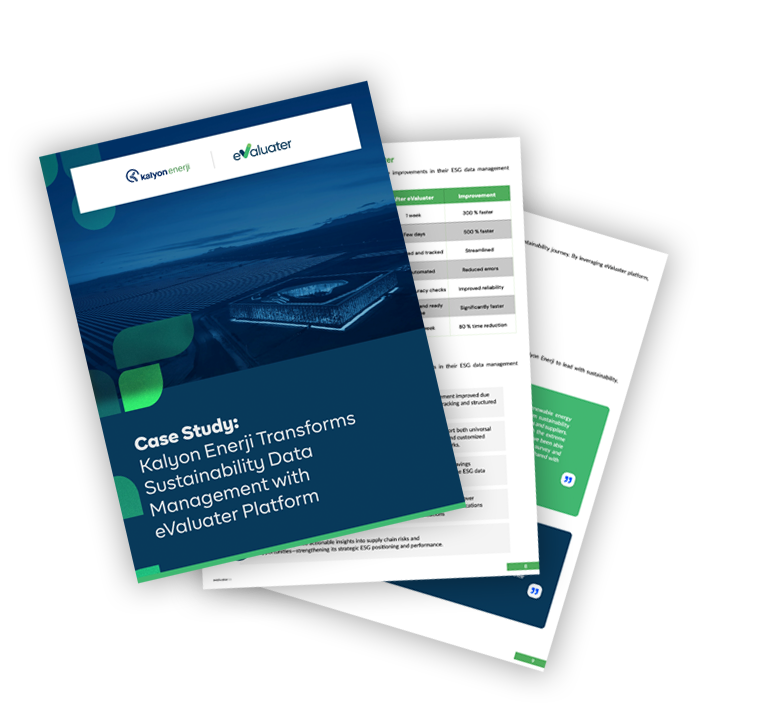
Measurable Efficiencies Realized with eValuater
With the implementation of eValuater, Kalyon Enerji realized transformative improvements in their ESG data management operations. Click here to learn more.