

GRI Global Reporting Initiative

The GRI Standards are the world’s most widely adopted framework for sustainability reporting. They enable organizations to be transparent about their impact materiality—specifically, how their activities affect the economy, environment, and people, including their human rights.
The GRI Modular System
The GRI framework is organized into a modular system of three interconnected series. To report "in accordance" with GRI, organizations must utilize all three.
| Standard Series | Focus Area | Application |
|---|---|---|
|
Universal Standards |
Foundations & General Disclosures |
Mandatory for all organizations (GRI 1, 2, and 3). |
|
Sector Standards |
Industry-Specific Impacts |
Required for organizations in specific high-impact sectors (e.g., Oil & Gas, Mining, Agriculture). |
|
Topic Standards |
Specific ESG Issues |
Used to report detailed information on material topics (e.g., Emissions, Waste, Biodiversity). |
Compliance Timeline & Recent Updates
The 2021 Universal Standards (GRI 1, 2, and 3) became the mandatory foundation for all reports published on or after January 1, 2023.
Key updates for 2025–2026 include:
- GRI 101: Biodiversity (2024): This new standard replaces GRI 304 and is effective for reports published on or after January 1, 2026.
- Sector Standards Expansion: New standards for Mining (GRI 14) are now effective, with Financial Services and Textiles currently in development.
- Interoperability: GRI has achieved high alignment with the European Sustainability Reporting Standards (ESRS). Organizations reporting under the EU's CSRD can now use GRI-ESRS mapping to avoid double reporting.
The 7-Step Reporting Journey
To ensure compliance and transparency, organizations should follow this structured process:
- Understand the GRI System: Familiarize yourself with the requirements of GRI 1: Foundation 2021.
- Apply Reporting Principles: Ensure all data meets the principles of accuracy, balance, clarity, comparability, completeness, and verifiability.
- Identify and Assess Impacts (Materiality):
- Understand the organization’s context (activities and business relationships).
- Identify actual and potential impacts on the environment and society.
- Assess the significance of these impacts to determine Material Topics.
- Engage Applicable Standards:
- Use Universal Standards for general disclosures.
- Use Sector Standards (if available) to identify likely material topics for your industry.
- Use Topic Standards to provide specific disclosures for each material topic.
- Prepare the Content Index & Statement of Use: Create a clear navigation map (the GRI Content Index) that directs stakeholders to specific disclosures.
- Publish and Declare: Publish the report and include a formal "Statement of Use" declaring whether the report is "In Accordance with" or "With Reference to" the GRI Standards.
- Notify GRI: It is a mandatory requirement to notify GRI of your report’s publication by emailing reportregistration@globalreporting.org.
Who Does GRI Apply To?
While GRI remains a voluntary global framework, it is increasingly used to meet mandatory legal requirements:
- Global Applicability: Any organization—regardless of size, sector, or location—can use GRI to enhance stakeholder trust.
- Regulatory Alignment (CSRD): In the EU, the Corporate Sustainability Reporting Directive (CSRD) now mandates ESG disclosures. Because GRI and the EU's ESRS are "interoperable," companies can use their GRI data to satisfy much of their legal obligation in Europe.
- Investor Demand: Beyond regulation, capital markets increasingly use GRI reports to assess non-financial risks and "impact materiality."
To Whom and How to Report
Reporting is directed at Stakeholders—a broad group including investors, employees, customers, suppliers, and local communities. Reports should be made digitally accessible, typically through a dedicated sustainability landing page or integrated within an annual report.
Master your impact materiality.
Simplify your GRI reporting process with guided disclosures and standardized data collection designed to build stakeholder trust.
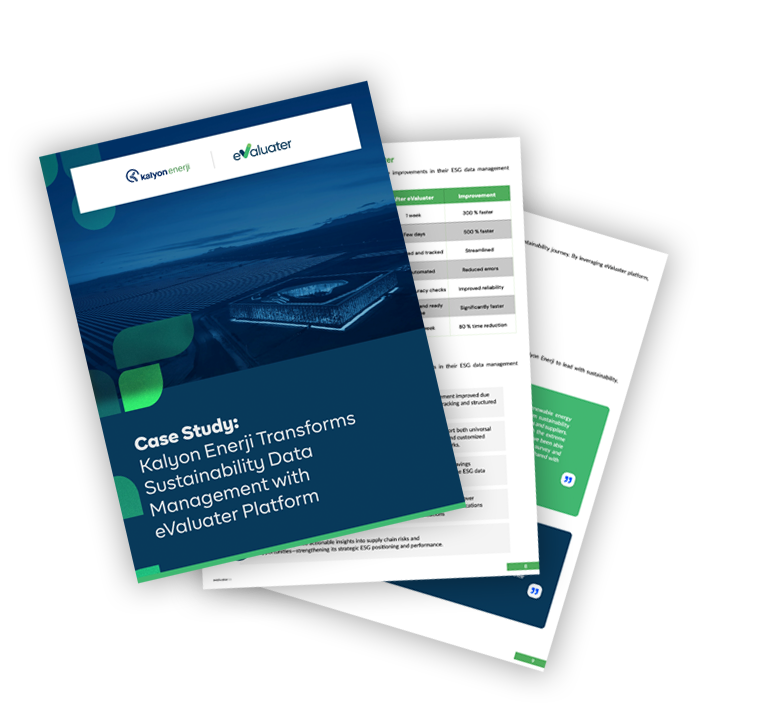
Measurable Efficiencies Realized with eValuater
With the implementation of eValuater, Kalyon Enerji realized transformative improvements in their ESG data management operations. Click here to learn more.