

ESRS European Sustainability Reporting Standards

The ESRS is the mandatory framework for sustainability reporting under the Corporate Sustainability Reporting Directive (CSRD). Unlike voluntary frameworks, the ESRS is legally binding and requires companies to report based on Double Materiality: how sustainability issues affect the company (financial materiality) and how the company impacts society and the environment (impact materiality).
The ESRS Modular System
The standards are divided into "cross-cutting" requirements that apply to all disclosures and "topical" standards focused on specific ESG categories.
| Category | Standard | Focus Area |
|---|---|---|
|
Cross-Cutting |
ESRS 1 & 2 |
General principles and mandatory general disclosures. |
|
Environmental |
ESRS E1 – E5 |
Climate change, pollution, water, biodiversity, and circular economy. |
|
Social |
ESRS S1 – S4 |
Own workforce, workers in the value chain, affected communities, and consumers. |
|
Governance |
ESRS G1 |
Business conduct and internal controls. |
2025–2026 Compliance Timeline & "Stop-the-Clock"
In 2025, the EU adopted the "Stop-the-Clock" Directive and the Omnibus I package to simplify the regulatory landscape. This has significantly delayed and narrowed the scope of the original CSRD.
- Wave 1 (Ongoing): Large, listed public-interest entities (>500 employees) began reporting in 2025 (for FY 2024).
- Wave 2 (Delayed): Non-listed large companies meeting new thresholds must now report starting in 2028 (for FY 2027), a two-year delay from the original plan.
- Wave 3 (Listed SMEs): Reporting is now postponed to 2029 (for FY 2028), with a further opt-out possible until 2031.
- Sector-Specific Standards: The development of industry-specific standards has been postponed to June 2026 to allow companies to focus on general reporting first.
Who Does ESRS Apply To? (Updated Thresholds)
As of late 2025, the EU has significantly raised the thresholds for CSRD scope to reduce the administrative burden on mid-sized companies.
An organization is now in scope for mandatory ESRS reporting if it exceeds at least two of the following criteria:
- Net Turnover: > €450 million (Raised from €40m/€50m).
- Balance Sheet Total: > €25 million.
- Employees: > 1,000 employees (Raised from 250).
Note: Member states have the discretion to exempt companies that fall below these new thresholds during the transition period (2025–2026).
Preparation: The 4-Step Compliance Path
- Conduct Double Materiality Assessment (DMA): Identify which ESG topics are material to your business. If a topic (e.g., Biodiversity) is deemed non-material, you may omit it, provided you explain the assessment.
- Gap Analysis: Compare your current data collection against the Amended ESRS (Dec 2025), which reduced mandatory data points by over 60% compared to the original drafts.
- Data Governance & Internal Controls: Align your sustainability data with financial reporting standards. ESRS requires limited assurance by a third party (auditor) from the first year of reporting.
- Digital Tagging Preparation: Ensure your reporting software supports the ESEF (European Single Electronic Format).
To Whom and How to Report: Digital & Unified
The report must be included in a dedicated section of the Management Report. It is no longer acceptable to publish a separate "Sustainability Report" PDF as the primary legal filing.
- Format: The report must be in XHTML format.
- Tagging: Information must be digitally "tagged" using iXBRL (Inline eXtensible Business Reporting Language) according to the ESRS digital taxonomy. This allows the data to be machine-readable and searchable via the European Single Access Point (ESAP).
Navigate the CSRD with confidence.
Streamline your ESRS alignment and automate your double materiality assessment with our step-by-step compliance toolkit.
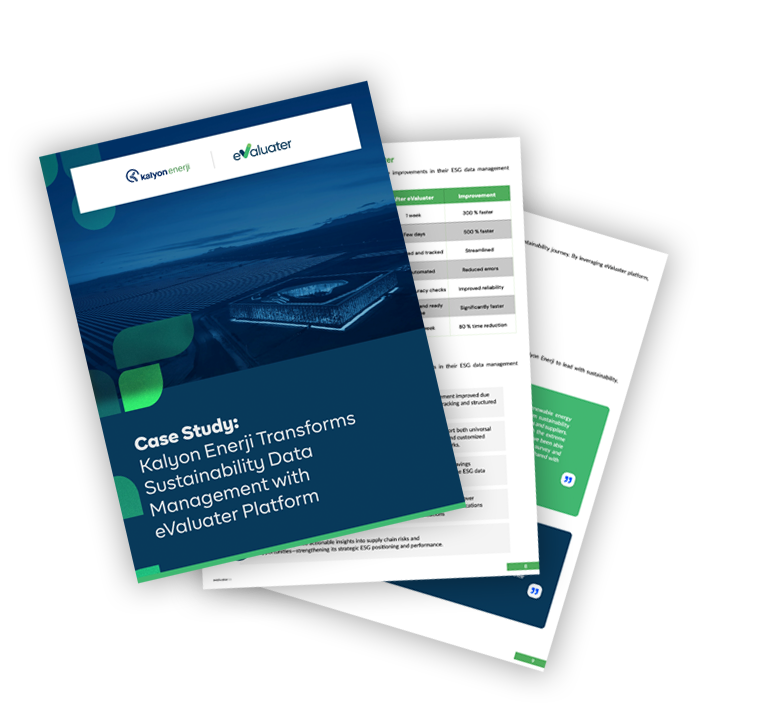
Measurable Efficiencies Realized with eValuater
With the implementation of eValuater, Kalyon Enerji realized transformative improvements in their ESG data management operations. Click here to learn more.