

ISSB International Sustainability Standards Board
The IFRS Sustainability Disclosure Standards, developed by the International Sustainability Standards Board (ISSB), provide a global baseline for high-quality sustainability reporting. Unlike the GRI (which focuses on social/environmental impact), the ISSB standards focus on financial materiality—how sustainability-related risks and opportunities affect a company’s cash flows, access to finance, and enterprise value.
The IFRS Sustainability Standards
The framework currently consists of two primary standards designed to be used together:
| Standard | Focus Area | Requirement |
|---|---|---|
|
IFRS S1 |
General Requirements |
Disclosing all material sustainability-related risks and opportunities that could affect the entity’s prospects. |
|
IFRS S2 |
Climate-related Disclosures |
Specific requirements for climate-related risks (physical and transition) and opportunities. |
Compliance Timeline & Framework Integration
The standards became effective for annual reporting periods beginning on or after January 1, 2024, with the first mandatory reports appearing in 2025 and 2026 across various jurisdictions.
Key 2025–2026 Updates:
- TCFD Integration: As of 2024, the ISSB has assumed monitoring responsibilities from the Financial Stability Board’s TCFD. Companies reporting under IFRS S2 are automatically considered compliant with TCFD.
- SASB Standards: Far from being obsolete, SASB Standards are a mandatory reference under IFRS S1. The ISSB is currently enhancing SASB’s 77 industry-specific standards to ensure they remain the primary tool for industry-based reporting through 2026.
- Transition Reliefs: In the first year of application, companies are granted "relief" allowing them to report only on climate-related risks (IFRS S2) before expanding to all sustainability topics (IFRS S1) the following year.
The 4-Pillar Reporting Structure
Both S1 and S2 follow the same structural pillars originally established by TCFD, ensuring consistency for investors:
- Governance: The processes and controls used to monitor sustainability risks.
- Strategy: How those risks and opportunities impact the business model and financial planning.
- Risk Management: How the company identifies, assesses, and prioritizes these risks.
- Metrics and Targets: The quantitative data (e.g., Scope 1, 2, and 3 emissions) used to measure performance.
Who Does IFRS (ISSB) Apply To?
While the IFRS Foundation sets the standards, individual countries decide when to make them mandatory. By 2026, over 40 jurisdictions have adopted or aligned with these standards.
- Global Adoption: Major markets including the UK, Canada, Brazil, Australia, and Singapore have moved to mandatory IFRS-aligned reporting for large and listed entities.
- Specific Focus: Türkiye: The Public Oversight Authority (KGK) has fully incorporated these as the Turkish Sustainability Reporting Standards (TSRS).
- Mandatory Scope (2026): Public interest entities (banks, listed companies) and large private companies that meet at least two of these thresholds:
- Total Assets: ₺500 Million
- Total Revenue: ₺1 Billion
- Employees: 250+
- Scope 3 Relief: Turkish companies are granted a two-year transition relief for Scope 3 GHG emissions, becoming mandatory for reporting periods starting January 1, 2026.
To Whom and How to Report
IFRS Sustainability Disclosures are designed for Investors, Lenders, and Creditors.
- Placement: Information must be provided as part of the General Purpose Financial Reports (Management Commentary).
- Timing: Sustainability disclosures must be published at the same time as the financial statements.
- Digital Reporting: Companies are increasingly required to use the IFRS Sustainability Disclosure Taxonomy to digitally tag data (XBRL), making it machine-readable for global investors.
Deliver investor-grade sustainability data.
Align your financial and sustainability disclosures seamlessly. Meet IFRS S1 and S2 requirements with precise, machine-readable reporting.
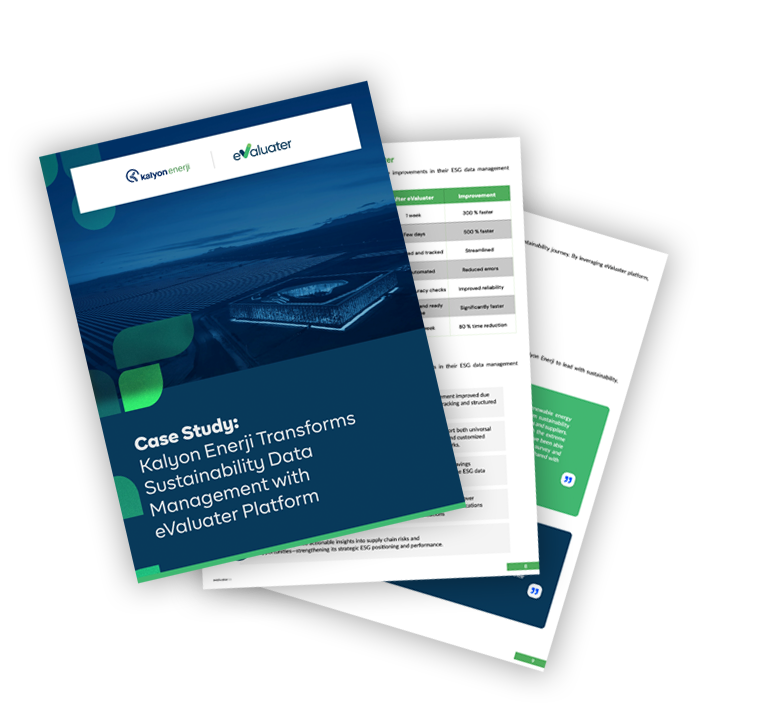
Measurable Efficiencies Realized with eValuater
With the implementation of eValuater, Kalyon Enerji realized transformative improvements in their ESG data management operations. Click here to learn more.