

TNFD Taskforce on Nature-Related Financial Disclosures
The TNFD is a market-led, science-based framework designed to help organizations integrate nature into their decision-making. Much like how TCFD addressed climate, TNFD provides a standardized language for disclosing nature-related dependencies, impacts, risks, and opportunities.
Its mission is to support a shift in global financial flows away from nature-negative outcomes and toward nature-positive outcomes, aligned with the Kunming-Montreal Global Biodiversity Framework (GBF).
The TNFD Modular System
The framework is built on a "building block" approach, ensuring it can be used alongside existing standards like GRI and ISSB.
| Component | Purpose |
|---|---|
|
Recommendations |
The 14 core disclosures structured around four pillars. |
|
LEAP Approach |
An internal assessment process (Locate, Evaluate, Assess, Prepare). |
|
Sector Guidance |
Specific metrics for 14 high-impact sectors (e.g., Mining, Food, Chemicals). |
|
Metrics & Targets |
A set of core global indicators and sector-specific metrics. |
2025–2026 Compliance Timeline & "The ISSB Handover"
The TNFD framework has moved from a "voluntary pilot" phase to a "global standard" phase.
- ISSB Standard-Setting (2025-2026): In a major shift, the ISSB (International Sustainability Standards Board) has officially begun developing a nature-specific standard (drawing directly from TNFD). An Exposure Draft is expected by October 2026.
- TNFD Technical Wind-down: TNFD will complete its final technical guidance by Q3 2026, after which it will pause new development to support the ISSB as the permanent global baseline.
- Rapid Market Adoption: As of early 2026, over 730 organizations—representing over $22 trillion in AUM—have registered as "TNFD Adopters," committing to publish disclosures by their 2026 fiscal year.
The LEAP Approach: From Assessment to Action
To meet the disclosure requirements, TNFD recommends the LEAP approach for internal assessment. This ensures that disclosures are backed by a rigorous, location-specific analysis of the business-nature nexus.
- Locate your interface with nature (where are your operations and value chain?).
- Evaluate your dependencies and impacts (what does your business need from nature, and how do you affect it?).
- Assess your risks and opportunities (financial, physical, and transition).
- Prepare to respond and report.
The 4-Pillar Disclosure Structure
Following the same logic as TCFD and ISSB (IFRS S1/S2), TNFD is organized into four pillars:
- Governance: The board’s oversight and management’s role in assessing nature-related issues.
- Strategy: The effects of nature-related issues on the organization’s business model and financial planning.
- Risk & Impact Management: The processes used to identify, assess, and prioritize nature-related issues.
- Metrics & Targets: The specific data used to measure performance against goals.
The 6 General Requirements
To ensure reports are "aligned" with the recommendations, preparers must follow these core principles:
- Materiality: Applying the definition of materiality consistent with the baseline standard used (e.g., ISSB for financial materiality or GRI for impact materiality).
- Scope of Disclosures: Clearly defining which parts of the value chain are included.
- Location: Disclosing the specific geographic locations where nature-related issues are most significant.
- Integration: Combining nature reporting with other sustainability and financial disclosures.
- Time Horizons: Considering short, medium, and long-term perspectives.
- Stakeholder Engagement: Describing the engagement with Indigenous Peoples, local communities, and affected stakeholders.
Who Does TNFD Apply To?
- Voluntary Leaders: Any organization seeking to manage nature-related risks and demonstrate "nature-positive" commitment.
- Regulated Entities (EU): Companies reporting under ESRS E4 (Biodiversity) will find that TNFD alignment covers the majority of their legal requirements.
- Target 15 Compliance: Governments are increasingly using TNFD to satisfy Target 15 of the Global Biodiversity Framework, which mandates that large/transnational companies disclose their impacts and risks.
To Whom and How to Report
Reporting is aimed at Investors and Stakeholders.
- Mainstream Filing: Disclosures should ideally be included in the Annual Management Report to sit alongside financial and climate data.
- Digital Integration: Preparers are encouraged to use the TNFD Digital Taxonomy to ensure data is machine-readable and interoperable with global databases.
Assess your dependencies on nature.
Start your journey toward nature-positive reporting. Identify, evaluate, and disclose your nature-related risks using our intuitive framework.
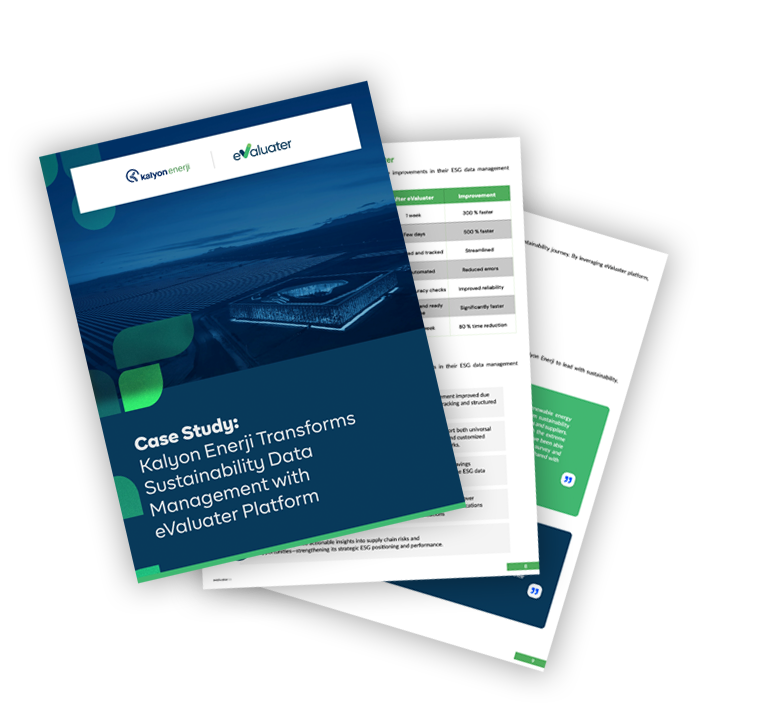
Measurable Efficiencies Realized with eValuater
With the implementation of eValuater, Kalyon Enerji realized transformative improvements in their ESG data management operations. Click here to learn more.